Tag Archives: urban beekeeping

Stress Testing the New Suit

One easy way to test that your suit is indeed bee proof is to simply knock over your hive. I find this gets the bees rather worked up and in fighting spirits. In my attempt today to confirm or deny Knives’ status, my hive slipped off the hive stand. Luckily there were only 3 medium supers remaining on the hive at the time, and I was able to use my cat-like reflexes to catch it before it tumbled to the ground. I had a heck of a time getting the hive wrestled back on the stand which was made slightly more difficult with a bunch of angry bees in my face.

The good news in all of this is my new suit’s reputation for being bee proof came through with flying colors. I obviously do not advocate kicking over your hive to test the integrity of your suit, but I’m trying to find the silver lining in today’s almost disaster.

I also believe I confirmed that my hive is indeed queenless. I had tons of drawn out frames with nothing in them. Considering it has been 30 days since I last saw eggs, it has been long enough that a new queen could have been raised and laying.

It was fortunate that my new queen arrived today. I first wanted to replace my existing hive stand with something more stable. The stand was nice, but the plastic made it very easy for the hive to move around when pulling off supers which is what caused the almost disaster today.

First, I broke down the hive.

Breaking down the hive.

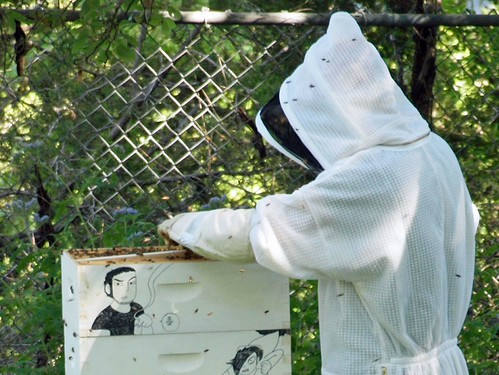
After I removed all the supers, I was able to take the old stand away and lay down two cinder blocks and level them. I then put the hive back together again to introduce the new queen. Here is the new queen attached to a frame ready to go.

New queen on frame.

I then added the frame to the hive. I’m hoping the hive will quickly accept her, free her from the cage, and she can start pumping out some brood.
Untitled

3 Comments

Filed under beekeeping, queens

The best-laid plans of bees and men…

I believe Knives’ hive may now be Knives-less. I inspected the hive this past weekend and didn’t see any sign of the queen and, more importantly, no signs of eggs either. I didn’t see any the previous weekend, but my inspection was cut short by a rain shower before I got too deep into the hive.

Here’s a shot of me in my fancy new Ultra Breeze suit going frame by frame looking for some sign of a laying queen.

Karl experiences the "pigpen" effect

My only other thought is perhaps the hive swarmed and the new queen hasn’t started laying yet. I did checkerboard the hive in late February, but perhaps that didn’t do the trick to suppress the swarm instinct.

Luckily, I have a new queen coming next week so all his not lost with Knives. After the Large Marge incident, I decided it was best to go ahead and requeen this hive with known gentle stock. I should get one more inspection in this weekend to hopefully confirm or deny if my hive is queenright. If I do find eggs, I can look forward to the fun task of finding an unmarked queen to “retire” before introducing the new queen. Otherwise, I can be fairly certain I can requeen with a minimal of fuss.

4 Comments

Filed under beekeeping

I think my suit is actually -5 against bees

After 4 solid days of wet cold weather in Austin, the sky opened up Sunday afternoon to clear blue skies and sun. I took the opportunity to check in on Knives’ hive as there is the potential for more wet weather later in the week.

The girls were very cranky which I’m hoping was due to them being cooped up in the hive for most of the week. Nowhere near as bad as Marge’s hive (who has set the bar incredibly high), but hotter than they were the previous weekend.

I got stung on my neck again in pretty much the same place as a few weeks ago. At least this time, it was just one instead of the 3-4 I got last time. I really feel that my suit and more specifically, my veil, is just not cutting it. I originally opted to go with a zipper suit and veil seen below as I thought it would be cooler in the summer as well as offering better peripheral vision.

Smoking Myself

However, I’m finding that the veil tends to bunch up in odd ways which tends to trap bees. It will also not always stay flared out so during an inspection so the veil will sometimes be right up against parts of my neck and hence the stinging.

I’ve decided to purchase one of the Ultra Breeze Suits. Several folks in Austin highly recommend them for being cool even in the summer and very sting proof. I’m hopeful it will arrive before my next inspection so I can put it through the paces.

6 Comments

Filed under beekeeping, equipment

Thanks for the memories…

Large Marge has now officially joined the Round Rock Honey empire. Last night, Konrad and Lance came out to Baab-Brock farms after sunset to get the hive all trussed up and ready for transport to a remote location where they can split and requeen the hive safely.

The first step was to give the hive a big blast of smoke to get all the bees hanging out at the entrance back inside. We then immediately taped up the front entrance to prevent any of the girls from deciding they weren’t going out without a fight.

We then applied a wrapping of tape along the seam of each super to prevent them from slipping while the hive was being moved. We started at the bottom and worked our way up until the bees decided to get smart and come out through the top inner cover. We had to quickly tape up around the telescoping outer cover and then we were good.

After all the supers were taped up, we then wrapped the hive in 4 straps to keep it securely together when we picked it up.

After that, we felt we were in no immediate danger from the hive. I’d also like to thank Knives for being chill during the whole procedure even though we were stomping around her hive as well.

Then it was just a matter of the three of us picking up the hive and making our way through the backyard and up to the truck. A six super hive is heavy, and it took all three of us lifting to make it work.

Here’s a final shot of me with Large Marge. I learned a lot about beekeeping with this hive, and it definitely makes me a little sad to see her go. I feel good though knowing she’ll be part of an excellent beekeeping operation

3 Comments

Filed under beekeeping

Lessons Learned

While we are still putting together a game plan on moving Marge’s hive, I thought it would be a good idea to run a post mortem on my experience with this hive. Not only will it help me formalize my approach to urban beekeeping in the future, but hopefully it will help some new beekeepers out there avoid an experience with an agressive and possibly AHB hive.

Talk to Beekeepers in the Area
If possible, get in touch with beekeepers who have hives in the general vicinity of where you plan on placing yours. Ask about the prevalence of AHB in the area, and if they personally experienced problems before. When I spoke to Konrad about Marge, he said that his hives south and south east of the river always seem to run hotter than his hives up north. Having this information ahead of time can help you make decisions on hive management and/or factor in to your decision on placing a hive in a certain area.

Requeening Philosophy
My initial game plan was to let my hives requeen themselves the old fashioned way with the thought of taking advantage of the feral bee population that had the genetics to survive the often extreme Texas seasons. In the case of Knives, this worked out well. The hive overcame a lot of initial hardships (pesticide poisoning, worst drought in 50 years, etc.), survived the winter, and is still mostly calm during inspections. Marge, not so much.

My new game plan is to requeen with known genetics for all my hives in urban areas. I’m lucky that Marge’s hive is in a location with no real neighbors on the sides or back of the property line otherwise the situation could have ended up a lot worse. My beekeeping friend said it best, “Queens are like a box of chocolates, you never know what you’re going to get.” This is especially true if they are mating with drones of unknown and potentially AHB origins.

While it will be more expensive to buy new queens, the expense totally outweighs the pain (literally) and heartbreak this hive has caused. It can also give you a chance to experiment with a lot of different breeds that are now available to see which works best for your style and area. I mean, who wouldn’t want to tell their beekeeping buddies about the new Tiger Queen you just installed.

Summary
Urban Beekeeping is a great hobby, and I hope my posts about this hive don’t discourage anyone from picking it up. I’ll be sure to have a follow up on moving Marge, and if I decide to requeen Knives this spring or wait until fall.

Leave a comment

Filed under beekeeping

When Good Girls Go Bad

When I wrote last week, I had a very harrowing experience with Large Marge’s hive and got stung several times on the neck. Her hive was very aggressive, and I went back the next morning when the temperature was just above 50 hoping the girls would not be as active. That was so not the case. Just opening the outer cover sent them boiling out of the entrance, and I decided that discretion was the better part of valor and quickly closed up the hive.

I reached out to a bunch of experienced beekeepers in the area, and most believed that the new queen in Marge’s hive mated with an Africanized drone thus eventually turning the hive into the aggressive mess I dealt with last weekend.

My initial plan was to requeen following the instructions by Michael Bush. I was a little nervous about this process especially after reading this paragraph:

First, Be prepared to be stung. Be prepared to walk away for a while. Be prepared to run away for a while. I find running through some brush is a good way to get rid of clinging and following bees.

Luckily, my beekeeping friend Jim Hogg was going to walk me through the process as he has lots of experience in these types of situations.

However, plans changed when one of the chickens of Baab-Brock Farms was found dead a few days later. All the chickens got chased around the yard for several hours when Marge’s hive was stirred up. We didn’t find any evidence of the chicken being stung to death, rather we think her poor heart gave out from the stress. The other three chickens are still alive and will most likely need counseling from this ordeal.

At this point, I felt the responsible thing to do was move the hive out of the neighborhood. I ended up selling the hive to Konrad of Round Rock Honey who will come move it to one of his remote apiaries. The current plan to is to move it one evening this week weather permitting. I’ve never moved a hive before, so this will be a new learning experience and extra precautions will be needed. I will certainly try and get pictures and write about the process in my next post.

2 Comments

Filed under beekeeping

Bee Starvation

It is not a very fun topic, but starvation is a major killer of managed bee hives each winter. Austin has experienced a very mild winter, which ironically, can put more of a strain on the hive’s resources than a cold one. We’ve had plenty of days where it is warm enough for the bees to go forage, but the energy expended finding food is no where near equal to what is available as most of the plants are dormant for the winter months. They would actually spend less energy clustered together in the hive if the temperatures were lower.

Luckily, most of the plants in Austin seem just as screwed up as well, and we are seeing a bloom cycle 3-4 weeks earlier than normal. The roses in my garden are about to go into full bloom when normally February 14th is the day in Central Texas where gardeners recommend pruning them.

This is why it is important to check your hives in the winter months on those mild days to ensure adequate foods stores still remain in the hive. If not, beekeepers usually recommend feeding granulated dry sugar as opposed to syrup during the winter as it is hard to keep the syrup over 50 F. If you find yourself in a situation where you have to feed in the winter, you will need to continue feeding until enough is blooming in the spring for the bees to become self-sufficient.

Leave a comment

Filed under beekeeping

Texas Barometer Bush FTW!

Leucophyllum frutescens, most commonly known as the Texas Barometer Bush, is said to bloom before a rainfall. This bush in my front yard burst into bloom in the middle of one of the worst droughts Texas has ever seen about a week before the rains finally came to Central Texas.

The bees in my neighborhood definitely appreciated the pollen and nectar and were all over this plant.

Bee on Texas Barometer Bush

Bee in Texas Barometer Bush

Texas is finally getting some much needed rain, and we are expected to get up to 3 inches through Tuesday. Hopefully this is the start of better weather for Austin and perhaps a fall nectar flow is now not a distant dream.

Leave a comment

Filed under beekeeping, pollination

Vegan Style!

Knives’ hive is busting at the seams so I decided to add the 3rd evil ex super to the hive today. In addition to the Ramona Commemorative super, this will be the 4th super overall. I wanted at least four filled out supers before winter to feel good about their chances making it through until next spring.

Added Super #4 (Vegan Style!) to Knives's hive

Brenna got some really nice shots of eggs and larvae in various states of development which is one of the reasons for the additional super.

Eggs and developing brood in Knives's hive

I’ll continue to feed the hive for the time being until we get some rain. It is starting to look promising with some rain falling in Austin this weekend and cooler temperatures on the way.

Feeding Knives some cheap honey to help her through the drought.

Leave a comment

Filed under beekeeping

What the heck is blooming?

Knives’ hive continues to amaze me. During today’s inspection, I noticed a lot of frames with new pollen stores plus there were a lot of foragers flying back in with full pollen sacs.

I really have no idea what could be blooming. I guess this is one of the benefits of having hives in an urban environment where people still keep their gardens alive even when the outlying areas are parched dry and on fire.

3 Comments

Filed under beekeeping, pollination