The Travis County Master Gardeners Association is a great resource for classes and seminars around gardening, lawn care, water harvesting, and now beekeeping has been added to the mix.
Bees love our Antique Roses
We have a large variety of antique roses on our property and unlike hybrid roses you buy at the florist, these roses haven’t been bred to death to look a certain way with no hint of pollen or scent.
We followed this bee first trying to force its way into an unopened bud of Rosette Delizy.

After an unsuccessful attempt on the Rosette Delizy, she decided that the Perle D’Or was more accessible.


Filed under pollination
October 9th Hive Check
My in-laws are visiting from Mumbai, and I was happy to have a beautiful October day to take them out to the hive. Unfortunately, the girls were a bit defensive this morning so they had to move to a safe distance to watch and avoid getting buzzed. Usually, I can get a couple supers deep before the girls get annoyed, but today they started chasing away the visitors from the beginning.
Even though Austin is in bloom, I think we could use another round of rain to keep the nectar flow going. Not much done with the empty honey super I put back on the hive after last week’s harvest, but all the other supers have plenty of activity.
I’ve been noticing a lot more drone cells this week and last. I even saw a drone starting to emerge, but was unable to get a good picture. They will probably enjoy another month of easy living, but then the hive will kick all the drones out in November when the weather cools down. Enjoy it while you can boys.
I haven’t seen Large Marge in forever, but her egg laying pattern is still awesome and the girls are producing some beautiful frames of brood. They are also stocking away pollen, and I’m really going to try and get a picture next week of a frame filled with multi-colored pollen.
Since I couldn’t get a lot of photos of the hive this week, here are some pictures of bees enjoying the fall blooms here in Austin. These are the girls on some Frostweed.
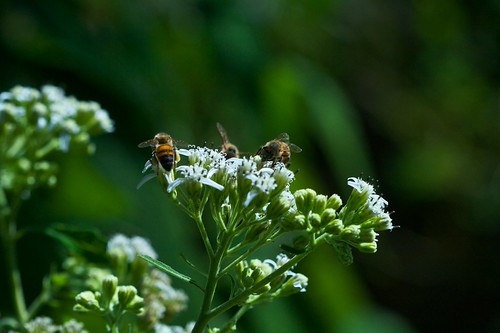

Kidney Wood is also in bloom and is very attractive to honey bees.

Filed under beekeeping, pollination
More clues on Colony Collapse Disorder
A joint research team between military scientists and entomologists have identified a tag team combination of a fungus and a virus that are both present in collapsed colonies. It may not be the smoking gun, but I’m always glad to read that research continues and progress is being made.
Filed under beekeeping, education, news
Fall Honey Harvest
The rains in August and September have made Austin green again and the fall nectar flow is on. I decided to do one last honey harvest before winter given the amount of available blooms that should be present at least for the month of October if not early November.
I was completely spoiled by using the bee escape for my first two harvests in early summer. For this harvest, I had two supers mostly filled with honey but wanted to mix and match frames to make sure I only took ones with completely capped honey so I had to use a bee brush to clear off the bees. By the end, they were not please with me at all. No stings, but a lot of angry buzzing around my head and the entire yard. I even had to put the chickens back in their coop in a full bee suit due to some unhappy girls.
I had two helpers for this harvest. The across the street neighbors have two young boys who were very interested in the process.


Even Harley wanted to share in the honey harvest and by sharing I mean making a bed out of my bee suit and gloves.

This honey was very different from the late spring/early summer harvest. From my previous post on the pollen analysis, the early honey (on the right) was primarily crepe myrtle, very light and clear, with a low viscosity. This harvest was a lot darker honey (on the left) and much more viscous with a richer flavor.

There is a slight chance I’ll get some more honey if this flow continues, but either way, I had a great first year, and the next steps will be preparing the hive for the winter months.
Filed under beekeeping
Former Jayhawk wins genius grant for her work with bees
I thought this was an interesting article.
Filed under beekeeping, education
It’s amazing what a little (okay a lot) of rain can do…
After a very hot and dry August, September has seen a higher than normal amount of rain due to some tropical storms in the Gulf working their way up to central Texas. When we left for India and France on August 31st, everything was brown and dry, but after a few short weeks of good rain, Austin is green again and all the plants are taking the opportunity to bloom once more.

The girls are also taking advantage of this new nectar flow and have drawn out comb in the 3rd super and have filled it almost all with brood. This is the super I added right before our trip so in three weeks they have drawn out comb on 8 new frames and already have capped brood.
The 4th super is now a mix between brood and honey with the 5th and 6th supers entirely honey. I really don’t want to add a 7th super on the hive which would effectively make the hive taller than me. Instead, I’m going to take advantage of this nectar flow and harvest some more honey next weekend.
Last inspection I also noted a lot of white pollen being stored in the hive and was curious about its source. We think we have solved this mystery. Bind Weed is everywhere now and upon closer inspection of the blooms, we noticed lots of white pollen on the tips of the stamen.

Our closer inspection also turned up lots of bees who are quite taken with this plant.

All in all, this hive has totally exceeded my expectations for my first year as a beekeeper, and I’m hoping for a good fall so that Large Marge and the girls will be prepared for the upcoming winter months.
Filed under beekeeping
Pollen Analysis – Breakdown
I meant to post this earlier, but here is the official breakdown of pollen in the honey sample I sent in.
| Pollen Taxa | Count | % | |
| ASTERACEAE (sunflower-type) | 1 | 0.5% | |
| BORAGINACEAE (borage) | 1 | 0.5% | |
| FABACEAE (legumes) | 1 | 0.5% | |
| LAMIACEAE (mint) | 2 | 0.9% | |
| Lagerstroemia (crepe-myrtle) | 162 | 75.3% | |
| Ligustrum (privet) | 17 | 7.9% | |
| LILIACEAE (lily family) | 7 | 3.3% | |
| Melilotus (clover) | 3 | 1.4% | |
| Prosopis (mesquite) | 20 | 9.3% | |
| Unknown pollen | 1 | 0.5% | |
| Totals | 215 | 100% | |
Filed under beekeeping, pollination
Pollen Analysis Results
I received my pollen analysis from Dr. Bryant this morning, and I was a bit shocked. It turns out the girls love the crepe-myrtles. Austin had great rains starting last fall into early summer, and I will say the crepe-myrtles had amazing blooms this year. I just never saw any bees on them. We have several in our yard and while I saw the occasional bee buzzing around the blooms, I just assumed they were not a major source of pollen or nectar.
Here is some of the technical information from the report:
Category I: contain less than 20,000 grains/10 g. Often, honey in this category represents samples that have been pressure-filtered, honey from floral sources that produce little pollen, honeys that were partly produced by sugar-feeding bees, or honey that has been adulterated by adding high-fructose syrup. Usually, honeydew honey samples also fall into this first category. Pollen concentration counts in Category II: contain between 20,000-100,000 grains/10 g and indicates the honey has come from normal floral sources. Category III: pollen concentration values range from 100,000-500,000 grains/10 g and represent floral sources that are high pollen producers or indicate that some of the comb storage cells containing pure pollen may have been mixed with the extracted honey. Category IV: includes pollen concentrations between 500,000-1,000,000 grains/10 g. That category along with honey in Category V: (containing pollen concentrations of more than 1,000,000 grains/10 g) indicate honey that is produced from a few different floral sources that are extremely rich in pollen (i.e., Myosotis sylvatica, Cynoglossum officinale).
Here is the official summary:
Your honey is an excellent example of a “Unifloral Honey” because it contains a dominant pollen type in the amount of 81%. For a unifloral honey, the International Bee Commission states you must have at least one pollen type in a percentage greater than 45%. The pollen concentration value of 35,650 pollen grains per 10 grams of honey is low, but it is within Category 2, which is in the range dominated by many Unifloral Honey samples. Because crepe-myrtle pollen is fairly large, much of it would normally be removed during a bee’s flight back to the hive. This phenomenon results in a low pollen concentration value in honey produced from the nectar of certain taxa, such as crepe-myrtle.
In addition to this honey being an excellent example of a Unifloral crepe-myrtle (Lagerstroemia sp.) honey, it also contains a small amount of nectar from another two sources, mesquite (Prosopis sp.), and privet (Ligustrum sp.). There are also a few other pollen types represented in this sample, which might reflect very minor foraging activity of your bees on other flowers such as those of clover (Melilotus sp.), some species of mint (LAMIACEAE the genus of which I cannot be certain since many mint types produce very similar pollen), and some species of plant in the lily family (Fig. 1). The lily pollen is very similar to the pollen of yucca (Yucca sp.) or crow poison (Nothoscordum sp.), but there are other pollen types that are nearly identical and thus without further work I could not be certain of the precise species that is represented. Overall, this is and excellent example of a good, unifloral crepe-myrtle honey.
Filed under beekeeping, pollination
Top bar hive vs. Langstroth (I’ve tried both and here’s my verdict) (via mistress beek)
Back in August, I posted an opinion that I thought Langstroth hives were probably better for beginner beekeepers, but as I have never used a Top Bar Hive, it was based purely on what I had read about them. Mistress Beek has used both and has an excellent summary on how she rates the two that I think is great.

via mistress beek
Filed under beekeeping, equipment


 Urban Beekeeping in Austin, Texas