Tag Archives: austin

Packages vs. Nucs

To follow up on my previous post about ordering bees, most apiaries offer two options in this regard: packages or nucs.

Packages
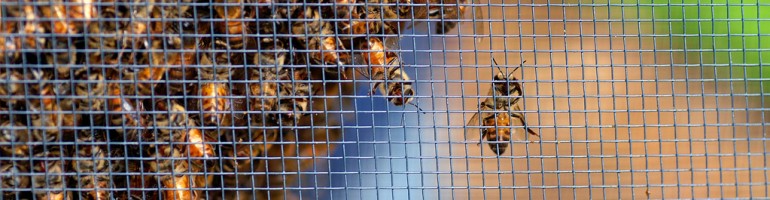
Ordering a package of bees is probably the most common way to get bees. A package consists of anywhere from 3-5 lbs. of bees in a large meshed box with a queen. You can refer to my previous post on installing Large Marge if you want to see what one looks like.

This is the cheapest option, and you can install these bees in any type of hive and/or hive type configuration. It also may be a little easier for a new beek to work with as all the bees are contained in one easy to dump out box. The downside of a package for someone starting with all new equipment is the bees have to draw out comb on all the frames before the queen can start laying eggs. Once the eggs are laid, you are then looking at another 21 days before you have new workers. This means you are waiting over a month before new bees start emerging to replace the ones you received with your package.

Nucs
Ordering a nuc gets you the same number of bees in a package plus a queen, but you also get the added benefit of several frames of drawn comb you can put directly into your hive. The advantage of this method is the comb will most likely have some honey as well as workers in various stages of development plus empty cells for the queen to lay eggs. This will give your hive a jump start on the season as they will be able to build up more quickly.

Nucs will cost you more, and you must have a hive to accommodate the types of frames the apiary uses. Most will use frames for deep body hive boxes so if you were like me and decided to standardize on medium boxes, this ruled out this option completely.

Summary
I don’t think one option is necessarily better than the other, but you should at least be aware of your choices so you can make the best decision for your hive and location.

Leave a comment

Filed under beekeeping, equipment

Time to Order Bees!

For anyone (especially those in Texas) who are thinking about starting your first hive, now is the time to place your order for a spring delivery. Beekeeping has become very popular in the past few years so if you wait too long to order, the apiary may no longer be able to fulfill your request. If that happens, you are either stuck waiting for an additional year, or getting lucky enough to catch an early spring/summer swarm.

Your local beekeeper association should be able to give you a list of reputable aparies that supply bees with good traits. The only two I know of in Texas are R Weaver and B Weaver aparies. I personally used B Weaver, and I’ve had great success my first year into beekeeping. I liked that fact that B Weaver had a local pickup option for your package (instead of them arriving in the mail) plus they stopped using chemicals to treat varroa mites in 2001 meaning their bees should be better adapted to cope with these pests.

So if you are thinking about taking the plunge into the exciting world of beekeeping, don’t delay and get your bees ordered!

Leave a comment

Filed under beekeeping, equipment

Bees love Blackfoot Daisy

What’s not to love about Blackfoot Daisy? It blooms all through the summer and fall, doesn’t need a lot of water, and actually smells like honey. It is no wonder the bees love it.

Leave a comment

Filed under beekeeping, pollination

The Elusive Pollen Frame

For weeks, I’ve been wanting to get either a photo or video of this one frame of multi-colored pollen that looks like stained-glass, and I was determined to make it happen this week.

Usually by the time I make it to the 3rd super where this frame is located, the girls are a bit worked up and the camera woman has to run to the house. The digital camera I have is old school, and you have to look through the view finder which is difficult while wearing a veil. I decided to try and get some video using my iPhone, but it is also difficult to operate while wearing gloves, but I managed to get some footage that isn’t terrible but not as focused as I wanted. Hopefully it conveys the variety of pollen that has been stored, and one of these days I’ll actually get a decent photo.

Leave a comment

Filed under beekeeping, pollination

Bumblebee!

This bee is huge. Right now, it is loving our fall aster which is a native Austin plant. It is so fuzzy I want to pet it, but I doubt it would appreciate the gesture.

Bumblebee on Fall Aster

2 Comments

Filed under beekeeping, pollination

Beekeeping Class in Austin on November 6th

The Travis County Master Gardeners Association is a great resource for classes and seminars around gardening, lawn care, water harvesting, and now beekeeping has been added to the mix.

Leave a comment

Filed under beekeeping, education

Bees love our Antique Roses

We have a large variety of antique roses on our property and unlike hybrid roses you buy at the florist, these roses haven’t been bred to death to look a certain way with no hint of pollen or scent.

We followed this bee first trying to force its way into an unopened bud of Rosette Delizy.
Bee on Rosette Delizy

After an unsuccessful attempt on the Rosette Delizy, she decided that the Perle D’Or was more accessible.
Bee on Perle D'Or

Bee on Perle D'Or

Leave a comment

Filed under pollination

October 9th Hive Check

My in-laws are visiting from Mumbai, and I was happy to have a beautiful October day to take them out to the hive. Unfortunately, the girls were a bit defensive this morning so they had to move to a safe distance to watch and avoid getting buzzed. Usually, I can get a couple supers deep before the girls get annoyed, but today they started chasing away the visitors from the beginning.

Even though Austin is in bloom, I think we could use another round of rain to keep the nectar flow going. Not much done with the empty honey super I put back on the hive after last week’s harvest, but all the other supers have plenty of activity.

I’ve been noticing a lot more drone cells this week and last. I even saw a drone starting to emerge, but was unable to get a good picture. They will probably enjoy another month of easy living, but then the hive will kick all the drones out in November when the weather cools down. Enjoy it while you can boys.

I haven’t seen Large Marge in forever, but her egg laying pattern is still awesome and the girls are producing some beautiful frames of brood. They are also stocking away pollen, and I’m really going to try and get a picture next week of a frame filled with multi-colored pollen.

Since I couldn’t get a lot of photos of the hive this week, here are some pictures of bees enjoying the fall blooms here in Austin. These are the girls on some Frostweed.

Bees on Frostweed

Bee on Frostweed

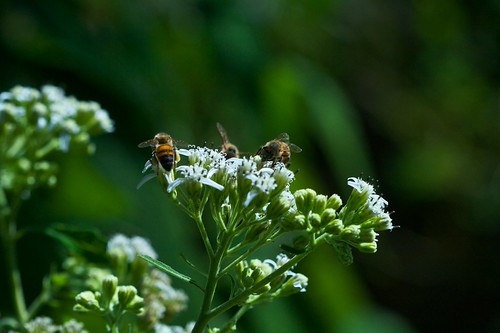
Kidney Wood is also in bloom and is very attractive to honey bees.

Bee on Kidney Wood

Leave a comment

Filed under beekeeping, pollination

Fall Honey Harvest

The rains in August and September have made Austin green again and the fall nectar flow is on. I decided to do one last honey harvest before winter given the amount of available blooms that should be present at least for the month of October if not early November.

I was completely spoiled by using the bee escape for my first two harvests in early summer. For this harvest, I had two supers mostly filled with honey but wanted to mix and match frames to make sure I only took ones with completely capped honey so I had to use a bee brush to clear off the bees. By the end, they were not please with me at all. No stings, but a lot of angry buzzing around my head and the entire yard. I even had to put the chickens back in their coop in a full bee suit due to some unhappy girls.

I had two helpers for this harvest. The across the street neighbors have two young boys who were very interested in the process.

Even Harley wanted to share in the honey harvest and by sharing I mean making a bed out of my bee suit and gloves.

Harley wants to beekeep when she grows up

This honey was very different from the late spring/early summer harvest. From my previous post on the pollen analysis, the early honey (on the right) was primarily crepe myrtle, very light and clear, with a low viscosity. This harvest was a lot darker honey (on the left) and much more viscous with a richer flavor.

Dark fall honey vs light spring honey

There is a slight chance I’ll get some more honey if this flow continues, but either way, I had a great first year, and the next steps will be preparing the hive for the winter months.

2 Comments

Filed under beekeeping

It’s amazing what a little (okay a lot) of rain can do…

After a very hot and dry August, September has seen a higher than normal amount of rain due to some tropical storms in the Gulf working their way up to central Texas. When we left for India and France on August 31st, everything was brown and dry, but after a few short weeks of good rain, Austin is green again and all the plants are taking the opportunity to bloom once more.

Everything is green again...

The girls are also taking advantage of this new nectar flow and have drawn out comb in the 3rd super and have filled it almost all with brood. This is the super I added right before our trip so in three weeks they have drawn out comb on 8 new frames and already have capped brood.

The 4th super is now a mix between brood and honey with the 5th and 6th supers entirely honey. I really don’t want to add a 7th super on the hive which would effectively make the hive taller than me. Instead, I’m going to take advantage of this nectar flow and harvest some more honey next weekend.

Last inspection I also noted a lot of white pollen being stored in the hive and was curious about its source. We think we have solved this mystery. Bind Weed is everywhere now and upon closer inspection of the blooms, we noticed lots of white pollen on the tips of the stamen.

Bind Weed

Our closer inspection also turned up lots of bees who are quite taken with this plant.

Bees love Bind Weed

All in all, this hive has totally exceeded my expectations for my first year as a beekeeper, and I’m hoping for a good fall so that Large Marge and the girls will be prepared for the upcoming winter months.

Leave a comment

Filed under beekeeping