Monthly Archives: June 2010

Week 10 Activities

It was a hot and humid morning in Austin even at 10:00 a.m. when I opened the hive. The 4th super was filled with bees drawing out comb which was a nice change from last week’s queen excluder mishap.
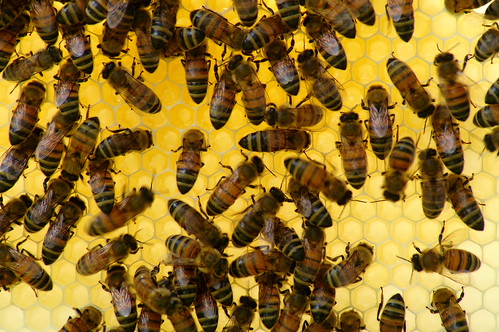
Bees drawing out comb in the fourth super

If this is even possible, the 3rd super seemed even more full of honey. All 8 frames were pretty much full up with only a few areas of capped brood.

Full Frame of Honey

I went ahead and moved some of these 3rd super honey frames up into the 4th super to encourage more bees to move up. Plus I’d like to see some brood in the 3rd super instead of all honey.

I ended up going all the way down to the 1st super today because my sticky board used for mite checks had fallen in the bottom board and I couldn’t remove it. I really didn’t want to do this, but I figured I better bite the bullet and just get it done.

Disassembled

The 1st and 2nd supers were mainly brood cells and pollen. There were a lot of open cells which initially had me worried, but a good majority seem to have eggs in them.

Busy bees

This is me with my wife after the hive was put back together. Did I mention it was hot today?

Beekeepers

Leave a comment

Filed under beekeeping

Häagen-Dazs Helping Bees

It is nice to see a company trying to do their part to help the plight of bees in this country. Häagen-Dazs has an informative web site on what they are doing to help.

They also have a fun little tool to create your own bee. Below is an artistic rendition of Large Marge.

Leave a comment

Filed under honey bee research

Need to move your bee hive? Here’s the lazy way. (via mistress beek)

This topic came up at the Austin Urban Beekeeping Meetup gathering this past Sunday. Hopefully, I will not have to move too many of my hives, but if I do, I’m going to try this method first.

Need to move your bee hive? Here's the lazy way. Inspired by Bush Bees, we decided to ignore the standard admonition about losing bees if you moved your hive more than 2 feet but less than 2 miles. (The rule of thumb is that if you’re moving your bees across the yard more than 2 feet, you’ll need to move them temporarily out 2 miles away so they don’t fixate on the old location.) Too much damn work. Instead, when a neighbor seemed fearful about a hive near his fence, we happily offered to move … Read More

via mistress beek

Leave a comment

Filed under beekeeping

The Latest in Bee Fashion

After my previous post on hives being stolen, I started to look around the internets for anything around hive security or bee tracking. I found an article from National Geographic which made me laugh mainly because of the picture below. The article is a few years old, but it is cool concept tagging bees to track their movements. However, I think they need to shrink the tags a bit before they can be used on honey bees.

Leave a comment

Filed under beekeeping

Hell Hath No Fury Like a Beekeeper Scorned

I found the following story last night, and I can’t even imagine trying to steal one hive let alone 48.

Ruben Josey, owner of Josey’s Honey Farm and vice president of the Beekeepers of Putnam County, was charged with two counts of dealing in stolen property after 48 beehives and related goods were located.

I know I would be pretty upset if I made a visit to my hive only to find the entire thing missing. Maybe I need to equip Large Marge with a GPS tracking device…

Leave a comment

Filed under beekeeping

Week 9 Inspection- Additional Information

Even though the 4th super was devoid of all but 6 brave bees that went through the queen excluder, there were still a lot of good signs in the hive. For one thing, the brood pattern on most of the frames was quite good meaning it was uniform without a lot of open cells in between.

Inspecting the frames

Frame inspection

I also saw Large Marge in the 2nd super. It is always nice to see your queen to confirm she is still there. While I didn’t see any eggs, there were plenty of capped brood plus larvae in various states before being capped. All in all, I think this is a healthy hive and hopefully with the queen excluder removed, the girls will draw out the 4th super to give them much needed room.

Leave a comment

Filed under beekeeping

Week 9 Inspection – Seriously Covered in Bees!

Last week I added a 4th super because Large Marge and the girls definitely needed more space.  Unfortunately, when I opened up the hive this morning, there were zero bees in the 4th super. I think this was due to both the queen excluder in between the 3rd and 4th super, and the fact that the 4th super had brand new undrawn frames. I put the excluder on when I added the 3rd super three weeks ago which in theory was suppose to get the girls used to going through it, but that theory is busted.

Below you can see me putting the hive back together and the girls are busting out at the seams. I was worried that this overcrowding would initiate a bunch of queen cells for a swarm, but I didn’t see any during my inspection. The 3rd super was almost all honey, and the other two were almost all brood. The bees were also a lot more feisty this morning probably due to all the honey in that 3rd super.

Bees Everywhere!

Adding the 3rd super back on the hive.

Bees Everywhere!

I removed the queen excluder and put the 4th super back on. Once they get comb drawn out, I can add it back on as long as I make sure Large Marge is in the 3rd super or below.

Lessons Learned:

  • Make sure your spectators don’t wear black so they look like bears. No one got stung, but there were a lot of close flybys and some chasing involved. My wife (for once) didn’t wear black this time and she was fine.
  • Only use the queen excluder if you have drawn out frames or you at least put one frame with honey in that super to entice the bees up.
  • Find exercises for low back strength. That 3rd super full of honey must have weighed 40 to 50 pounds. I’m so glad I decided to go with medium supers for my entire hive. I can’t even imagine lifting a full deep brood box without some sort of system of levers and pulleys.

Leave a comment

Filed under beekeeping

Butterfly Pollination

My purple coneflowers have been attracting a lot of butterflies recently which got me thinking about butterfly pollination while I was trying to get close enough to snap the picture below.

Butterfly on Coneflower

I found an article from our friends at Texas A&M that confirms that while butterflies may not be the most efficient pollinators around, they do their part and certainly look beautiful in the process. Butterfly populations are also on the decline due to loss of habitat and improper use of pesticides. So for all those beekeepers out there planting “bee-friendly” flora, do a little research and throw something in for the butterflies.

Leave a comment

Filed under pollination

Counting Brood or Math is Hard

Edit: I had to edit the post because apparently math is hard, and the previous post had the rate of change and not the egg per day estimate.

Last night, I attended a webinar entitled “6 Weeks as a Beekeeper,…Now What?”. It was put on by Brushy Mountain Bee Farm, and Kim Flottum was one of the guest speakers. I thought it had a lot of good information although it did run almost an hour long so be prepared to set aside 2 hours if you want to listen to the entire replay.

One of the best suggestions I got from the webinar was counting capped brood in your hive over time to get a trend on how many eggs your queen is laying per day. It does require some guesstimation on your part, but I thought it was a good idea overall. First, you estimate the percentage of capped brood on a each of the frames in your colony. For this example, let’s say you have 6 frames that are 50% full of capped brood. Depending on your frame size, you can then get an estimate on the number of capped cells. I use medium frames that have approximately 6300 cells per frame. Deep frames have around 9000 cells per frame. These numbers include both sides.

6 frames x 6300 cells x 50% full = 18900 cells of capped brood

Since capped brood take 12 days to emerge, you divide that number by 12 to get the eggs per day from a period of 9-21 days ago.

18900 cells / 12 = 1575 eggs a day

You then check your hive exactly 12 days later and calculate the number of capped brood again to check the difference in egg production.

Since they say a good queen will lay around 1500 eggs a day, in this example, the number is right on the money and your queen is doing well. Obviously this is not an exact science, but it is an idea I’m going to put into practice to see how Large Marge is doing.

Since this was a bit of a dry post, here’s a shot of two adorable bees from my hive.

Best Friends Forever!

Leave a comment

Filed under beekeeping