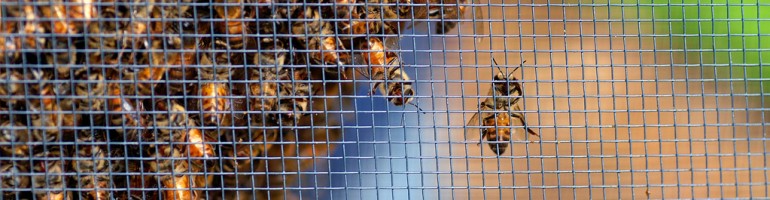
After my previous post on hives being stolen, I started to look around the internets for anything around hive security or bee tracking. I found an article from National Geographic which made me laugh mainly because of the picture below. The article is a few years old, but it is cool concept tagging bees to track their movements. However, I think they need to shrink the tags a bit before they can be used on honey bees.
Tag Archives: urban beekeeping
Week 9 Inspection- Additional Information
Even though the 4th super was devoid of all but 6 brave bees that went through the queen excluder, there were still a lot of good signs in the hive. For one thing, the brood pattern on most of the frames was quite good meaning it was uniform without a lot of open cells in between.
I also saw Large Marge in the 2nd super. It is always nice to see your queen to confirm she is still there. While I didn’t see any eggs, there were plenty of capped brood plus larvae in various states before being capped. All in all, I think this is a healthy hive and hopefully with the queen excluder removed, the girls will draw out the 4th super to give them much needed room.
Filed under beekeeping
Week 9 Inspection – Seriously Covered in Bees!
Last week I added a 4th super because Large Marge and the girls definitely needed more space. Unfortunately, when I opened up the hive this morning, there were zero bees in the 4th super. I think this was due to both the queen excluder in between the 3rd and 4th super, and the fact that the 4th super had brand new undrawn frames. I put the excluder on when I added the 3rd super three weeks ago which in theory was suppose to get the girls used to going through it, but that theory is busted.
Below you can see me putting the hive back together and the girls are busting out at the seams. I was worried that this overcrowding would initiate a bunch of queen cells for a swarm, but I didn’t see any during my inspection. The 3rd super was almost all honey, and the other two were almost all brood. The bees were also a lot more feisty this morning probably due to all the honey in that 3rd super.
Adding the 3rd super back on the hive.
I removed the queen excluder and put the 4th super back on. Once they get comb drawn out, I can add it back on as long as I make sure Large Marge is in the 3rd super or below.
Lessons Learned:
- Make sure your spectators don’t wear black so they look like bears. No one got stung, but there were a lot of close flybys and some chasing involved. My wife (for once) didn’t wear black this time and she was fine.
- Only use the queen excluder if you have drawn out frames or you at least put one frame with honey in that super to entice the bees up.
- Find exercises for low back strength. That 3rd super full of honey must have weighed 40 to 50 pounds. I’m so glad I decided to go with medium supers for my entire hive. I can’t even imagine lifting a full deep brood box without some sort of system of levers and pulleys.
Filed under beekeeping
Counting Brood or Math is Hard
Edit: I had to edit the post because apparently math is hard, and the previous post had the rate of change and not the egg per day estimate.
Last night, I attended a webinar entitled “6 Weeks as a Beekeeper,…Now What?”. It was put on by Brushy Mountain Bee Farm, and Kim Flottum was one of the guest speakers. I thought it had a lot of good information although it did run almost an hour long so be prepared to set aside 2 hours if you want to listen to the entire replay.
One of the best suggestions I got from the webinar was counting capped brood in your hive over time to get a trend on how many eggs your queen is laying per day. It does require some guesstimation on your part, but I thought it was a good idea overall. First, you estimate the percentage of capped brood on a each of the frames in your colony. For this example, let’s say you have 6 frames that are 50% full of capped brood. Depending on your frame size, you can then get an estimate on the number of capped cells. I use medium frames that have approximately 6300 cells per frame. Deep frames have around 9000 cells per frame. These numbers include both sides.
6 frames x 6300 cells x 50% full = 18900 cells of capped brood
Since capped brood take 12 days to emerge, you divide that number by 12 to get the eggs per day from a period of 9-21 days ago.
18900 cells / 12 = 1575 eggs a day
You then check your hive exactly 12 days later and calculate the number of capped brood again to check the difference in egg production.
Since they say a good queen will lay around 1500 eggs a day, in this example, the number is right on the money and your queen is doing well. Obviously this is not an exact science, but it is an idea I’m going to put into practice to see how Large Marge is doing.
Since this was a bit of a dry post, here’s a shot of two adorable bees from my hive.
Filed under beekeeping
It’s pronounced nucular…
A nuc or nucleus hive is a smaller version of a normal 10-frame or 8-frame hive that can be used to catch swarms or make splits of an existing hive. Brushy Mountain had a sale on a 5 frame complete Nuc back in April, and I decided it might come in handy some day.
I decided to have a bit of fun with this hive so I painted it yellow with radioactive symbols on the side as a play on the word nucleus. I give to the world the Nuclear Hive (please make sure you pronounce it correctly).
Filed under beekeeping
Week 8 Activities
I think summer has finally arrived in full force in Austin making inspections a very hot affair. I think most beekeepers will be sporting styling baby blue sweat bands this season.
The girls had gone to town on the 3rd super and most of the frames were drawn out with wax. Large Marge was also spotted in the 3rd super. I didn’t see any eggs, but there were plenty of larvae in various stages of development.
The 2nd super contained the beetle blaster, and I was happy to see several dead beetles floating in the mineral oil.
The frames in the 2nd super had a bunch of honey as well as capped brood. I think a bunch of bees just emerged from this frame as there was one right in the middle making its way out of its cell. Unfortunately, the crop was too blurry to post, but I’m hopeful to one day get a shot of a new bee emerging.
It looked like there may have been a queen cell on the bottom of the frame where my hive tool is pointing. However, it didn’t look like the textbook examples of what a queen cell is supposed to look like. There was definitely some kind of bee inside the cell when I scraped it away. Here’s a closer view, and I would appreciate a second opinion.
Since the 3rd super was getting full, I added a 4th super to the hive. I put the queen excluder between the 3rd and 4th supers to make the top super purely a honey super. I also removed the entrance reducer because I felt the girls were getting a little cramped with only half the entrance available. Large Marge and her hive have come a long way since April, and I’m excited to see what the next few months bring.
Filed under beekeeping
Week 7 Activities
On a hot and muggy Sunday, I opened up the hive for my week 7 inspection. Time has flown by quickly, and I’m amazed how quickly Large Marge and crew have built up the hive. The 3rd super I added last week had a lot more comb on it than I expected which is great. I was a bit worried that I might have to put the feeder back on since sometimes bees are reluctant to draw out comb on new plastic foundation, but the frames are progressing nicely. This tells me there is still good nectar flow around Austin.
The 2nd super is where I placed the Beetle Blaster. You can see me below inspecting the trap and noticing the lack of blasted beetles. Either the jingle has lied to me, or I don’t have enough beetles in the hive that need blasting. I did notice a few running around which were promptly squished, but hopefully the girls are keeping them under control.
Bees store both pollen and honey in cells. Below is a good shot of cells filled with pollen surrounded by uncapped honey. Technically, it is not even honey yet but nectar that hasn’t been cured meaning the water content is still too high to be considered honey.
I also thought I found a swarm cell, but I believe it is just some burr comb which refers to bits of random wax combs built basically where you don’t want it to be built. I scraped it off my handy dandy hive tool. This is also a great photo showing a frame of capped brood which are baby bees in their final stage of becoming a worker.

Filed under beekeeping
What is going on here?
You can read all the books in the world about beekeeping, and while you can get a good idea of the fundamentals, nothing beats experience on how bees behave.
Take the photo below. I have no idea what the girls are doing. My best guess is they are fanning the hive entrance for temperature control, but they could just as well be practicing their Cirque de Soleil routine. Nothing else seems amiss, so right now I just have to assume everything is fine, and this is some normal bee behavior I haven’t experienced yet.
If anyone has any ideas, I would certainly welcome any feedback.
Filed under beekeeping
I guess some Aggies aren’t half bad…
One of the first things I will do when I harvest my first crop of honey is to send a sample off to Dr. Vaughn Bryant at Texas A&M for a pollen analysis. The last I checked, for $50, he will tell you all the different pollens in your honey and at what percentage they exist. This can give you a good idea of what flora your bees are visiting. In my opinion, the more plant diversity available to your bees, the better your honey tastes.
Dr. Bryant is also being asked to determine the point of origin of honey from imports using pollen markers. In particular, China is flooding honey into U.S. markets, and let’s just say what you get isn’t always pure honey.
Filed under beekeeping
Week 6 Activities
After pouring down rain all day Friday and early Saturday morning, the weather finally cleared. With a threat of thunderstorms on Sunday, I figured I should take advantage of the break in the weather to perform the inspection.
The girls were exceptionally non-agressive this morning except for the one below. You can also see me installing the Beetle Blaster (click the link for the best jingle ever) between two frames that will hopefully catch any pesky small hive beetles lurking about. I did not see any evidence of them on the frames which is awesome and hopefully it will remain that way.
I also finally have a good shot of Large Marge. She’s the larger bee with the green dot on her back for easy identification. The dot colors are actually standardized by the year the queen was hatched so it easy to tell how old your queen really is.
I also added a 3rd super to the hive. I did find one swarm cell in the 2nd super so I decided it was probably a good idea to add the 3rd even though I would have rather seen a bit more comb drawn out on the frames. However, I would say a good 5 out of the 8 frames were drawn out, so adding an extra super is not causing me a lot of heartburn. Next week I’ll check the progress on the frames in this super since they all have new plastic foundation. I may have to put the feeder back on to give them an extra boost of wax production.
Filed under beekeeping